
Yisan Yisi ClothingCustomized manufacturer of mid to high end sweaters
Yisan Yisi ClothingCustomized manufacturer of mid to high end sweaters
Knitwear production process involves a number of links, each link has its own specific precautions, the following is a detailed introduction:
I. Prenatal preparation stage
Fabric inspection
After receiving the fabric, strict fabric inspection is carried out to ensure its quality and suitability. The inspection contents include the color, texture, shrinkage rate, warp and weft density of the fabric.
Use the "four-point scoring method" and other standards to evaluate the fabric defects to ensure that the fabric quality meets the production requirements.
Pine treatment
Knitted fabrics need to be treated with pine cloth, usually for 24 hours or 48 hours to reduce shrinkage after cutting.
Preparation before cutting
Determine the number of layers according to the fabric composition to avoid the size deviation caused by the blade is not sharp when cutting.
Test the shrinkage of the fabric and adjust the pattern according to the shrinkage to ensure that the size of the cut piece is accurate.
Two, cutting and sewing stage
Cropping
Perform precise cutting to ensure accurate cutting size and standard shape.
After cutting, check the cut piece and replace the defective piece in time.
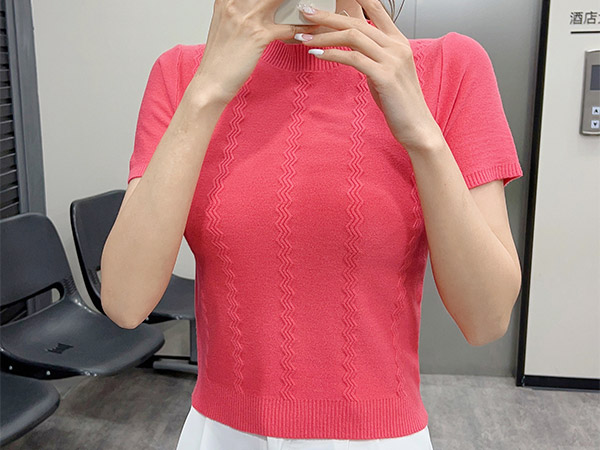
Binding and sewing
Edging is one of the main processes of knitting clothing, pay attention to the density, width, line color and quality of the edging as required.When sewing, pay attention to the tightness of the stitches, the uniformity of the stitch distance and whether the color of the stitches matches the fabric.
For parts with special requirements, such as necklines, cuffs, etc., special sewing techniques and skills should be used to ensure that their shape is stable and their size is accurate.
Auxiliary material treatment
Knitwear may need to be matched with some webbing, rubber and other accessories, but the shrinkage of these accessories is difficult to match with the fabric. Therefore, it is necessary to preshrink the fabric first, and at the same time, the accessories with shrinkage can be ironed first.
Three, ironing and inspection stage
Ironing
Adjust the temperature of the iron according to the performance characteristics of the fabric to ensure the ironing effect.
Thicker parts can not be grinding back and forth, dark fabrics can not be pressed hard, so as to avoid mirrors, reflections, etc.
Knitted fabrics are more elastic, and ironing plays a great role in controlling the fabric size, so it is necessary to fix the size in the early stage.
Garment inspection
Garment inspection is the last process of knitted clothing entering the sales market, which plays a pivotal role.
The inspection contents include whether the overall appearance is clean and clean, whether the thread is handled cleanly, whether the ironing of each part is flat or flat, and whether the sewing line is smooth and firm.
The parts of the grid, bar and flower shall conform to the standards of the contract or the provisions of the transaction sample.
4. Packaging and storage stagePackaging
After the finished product is completed, it enters the packaging workshop for sorting and packaging, including hanging tags, needle inspection, etc., to ensure product safety.
When the inner packaging is plastic bag packaging, it is necessary to pay attention to whether the clothes in the plastic bag are smooth and symmetrical, and whether the size of the plastic bag is appropriate. The outer packing mark should be correct.
Storage
The storage environment should be dry and hygienic, and there should be no direct sunlight.
The size of the outer box can not be too high, so as not to cause damage to the bottom box.
Five, other precautions
Equipment use and maintenance
Knitwear production needs to use a variety of special equipment, such as overlock sewing machine, two-needle sewing machine, three-needle sewing machine, etc. We should understand the characteristics of various special machine stitches, and correctly use and maintain the equipment to ensure production efficiency and product quality.
Process requirements and operating specifications
Different knitwear styles and fabrics may require different process requirements and operating specifications. In the production process, it is necessary to produce in strict accordance with the process requirements and operating specifications to ensure product quality and production efficiency.
Staff training and Quality management
Strengthen staff training, improve staff quality awareness and operational skills. At the same time, the establishment of strict quality management system and inspection standards, quality monitoring and inspection of each link in the production process to ensure that product quality meets customer requirements.
In summary, the production process of knitted clothing needs to pay attention to many aspects of the problem, including prenatal preparation, cutting and sewing, ironing and inspection, packaging and storage and other precautions. Only in strict accordance with the production requirements and operating specifications of production, in order to ensure product quality and production efficiency.