
Yisan Yisi ClothingCustomized manufacturer of mid to high end sweaters
Yisan Yisi ClothingCustomized manufacturer of mid to high end sweaters
When knitting short-sleeved sweaters, you need to pay attention to the following key details:
Needle and wire selection:
Select the appropriate rod according to the thickness of the wire. For example, 3.75~5.0mm rods can be used for thick lines, 3.0~3.5mm rods can be used for medium thick lines, and 2.25~2.75mm rods can be used for thin lines.
For beginners, because they can not grasp the tightness of the thread well, it is best to use two needles when starting the needle, and choose a needle two sizes smaller than the knitting needle number to start the first line, and then change the selected needle number when weaving a good head to ensure that the edge is smooth.
Short sleeve sweaters suitable for use of good air permeability, suitable for summer wear, such as linen, silk or cotton thread.
Knitting sample and calculated number of stitches:
Before the formal knitting, first weave a small sample to understand the knitting density under the wire and rod combination (i.e. the number of stitches and rows required per centimeter).
Calculate the number of stitches required based on the knitting density of the sample and the required piece size.
Body knitting and shoulder folding:
When weaving the body, ensure that the stitch is uniform to avoid uneven tightness.
According to the design requirements, start the shoulder in the appropriate position. When the shoulder is closed, the number of stitches should be gradually reduced and the process of needle reduction should be smooth and natural.
Pay attention to the symmetry and balance of the front and back pieces to ensure comfort and beauty when wearing.
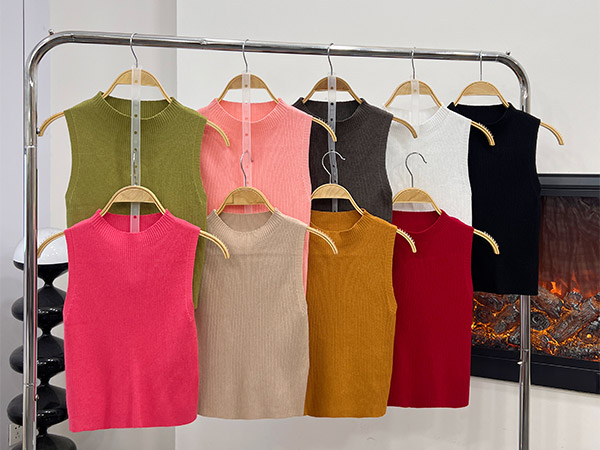
Sleeve weaving and sleeve hill treatment:
Sleeve length should be moderate, not too long or too short.
The reduction of the sleeve hill should be handled properly to ensure that the curvature of the sleeve fits perfectly with the armpit part of the body.
The cuff hill part can be folded flat for a certain number of stitches to form a rounded cuff.
Collar and cuff treatment:
The size and shape of the neckline should be determined according to personal preference and design needs. Generally speaking, the neckline should not be too tight or too loose to ensure comfort and beauty when wearing.
Cuff parts can be woven into ribbed edges or elastic edges to increase elasticity and comfort.
Suture and finishing:
When stitching pieces and sleeves, make sure that the stitching is smooth and natural to avoid wrinkles or unevenness.
Carry out the necessary finishing of the sweater, such as trimming the thread, ironing, etc., to improve its overall beauty and comfort.
Water cleaning and shrinkage prevention:
After the knitting is completed, it is recommended to wash the short-sleeved sweater once in the water to remove excess wool and impurities, and check the shrinkage.
When cleaning, it is necessary to follow the washing instructions of the wire, avoid using high temperature water or strong detergent, so as not to damage the yarn or cause serious shrinkage.
In summary, when knitting short-sleeve sweaters, it is necessary to pay attention to several details, such as needle and wire selection, knitting sample and calculated needle number, body knitting and shoulder folding, sleeve knitting and sleeve hill treatment, neckline and cuff treatment, stitching and finishing, and water cleaning and shrinkage prevention. Only these aspects are handled properly, in order to weave a beautiful and comfortable short-sleeved sweater.